
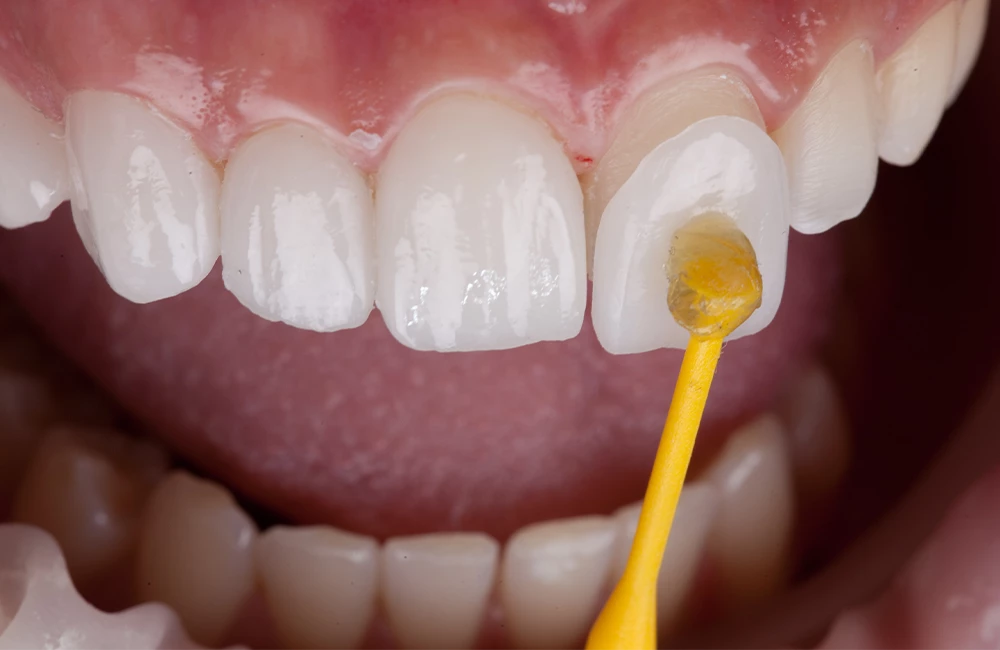
Porcelain veneers are one of the most searched treatments among international patients visiting our clinic. The price difference between Dubrovnik and the UK or Italy is large enough that most patients recover the full cost of their flights and accommodation — and still pay significantly less overall.
What the numbers look like
At our clinic, porcelain veneers are priced between €290 and €380 per tooth, depending on the type of veneer and laboratory used. A ten-veneer smile makeover therefore costs €2,900–€3,800 in total. The equivalent treatment at a central London clinic typically runs to £6,000–£10,000, and at an Italian practice in Rome or Milan to €7,000–€12,000. The gap reflects the lower cost base in Croatia and the absence of overheads carried by clinics in capital cities — not a difference in standards or materials.
What is included
Our veneer price includes the full consultation, all preparatory work, temporary veneers during the fabrication period, fitting, and a follow-up review. We use lithium disilicate (e.max) or feldspathic porcelain from certified European laboratories. If you would like a specific quote based on your case, send us a photograph and we will respond within 24 hours.
Types of veneers and how to choose
Not all veneers are the same, and the right choice depends on your existing teeth, your goals, and how much natural tooth structure you want to preserve.
Lithium disilicate veneers, made from e.max ceramic, are the most commonly placed type at our clinic. They are strong, thin, and produce a result that sits within the natural range of tooth appearance — neither unnaturally bright nor obviously artificial. They work well for patients who want a reliable long-term improvement without a dramatic change to the overall look of their smile.
Feldspathic porcelain veneers are more translucent and tend to be the preference when a very natural, lifelike result is the priority. They are more technically demanding to apply and slightly more delicate than e.max, but in the hands of an experienced ceramicist they produce results that are difficult to distinguish from natural enamel. They suit patients who have healthy, well-positioned teeth and want to refine rather than transform.
The consultation is the right moment to discuss which material suits your case. We do not apply a one-size approach. The recommendation will be based on what you are starting with, what you want to achieve, and what will hold up best over time.
The consultation and planning process
The process begins before you travel. When you contact us, we ask you to send a clear photograph of your current smile and a brief description of what you would like to change. From this we can give you an honest initial assessment and an indicative cost range. If veneers are appropriate for your case, we will explain why. If a different treatment would give you a better result, we will say so.
When you arrive in Dubrovnik, your first appointment covers a full clinical examination, digital X-rays where needed, and a detailed conversation about the outcome you have in mind. We discuss the shade, shape, and length of your planned veneers. Many patients bring reference photographs, which is helpful. We take impressions or digital scans at this stage, which are sent to the laboratory.
Temporary veneers are placed while the final restorations are being made. These allow you to experience the approximate shape and length of the result and to give feedback before the final pieces are bonded. Small adjustments can be made to the temporaries if something does not look or feel right.
How many visits are needed
For a veneer case, most patients need two main appointments, with a day or two between them for laboratory fabrication. The first appointment covers preparation and temporaries. The second covers fitting and bonding of the final veneers. Altogether, most patients plan for four to six days in Dubrovnik.
If you are combining veneers with other work — whitening the lower teeth, a crown on a back tooth, or any restorative treatment — additional appointments may be needed and we will confirm the schedule clearly in advance.
How to plan the trip around treatment
Dubrovnik is well connected by direct flights from London, Manchester, Edinburgh, Dublin, Rome, and other European cities. The journey is straightforward. Many patients fly in on a Sunday, have their first appointment on Monday, and leave by the following Saturday with the work complete.
We recommend not planning anything too demanding — long hikes, boat trips, evening events — on appointment days, as sessions can run two to three hours. The days between appointments are free, and Dubrovnik is a rewarding place to spend that time. The old town, the island of Lokrum, and the surrounding Adriatic coast are all easily reached from the centre.
Accommodation at various price points is available within walking distance of the clinic. We are happy to point patients in the right direction if needed.
What questions to ask before committing
Before agreeing to veneer treatment anywhere — in Dubrovnik or elsewhere — it is reasonable to ask which materials and laboratory will be used, how much tooth preparation is involved, and what the expected lifespan of the veneers is. You should also ask what happens if a veneer chips or comes loose after you return home.
We are transparent on all of these points. Our veneers are made in accredited European laboratories, preparation is conservative wherever possible, and we remain reachable for any questions after you return. We do not treat patients as visitors passing through — we treat them as patients, with the same continuity of care we would offer anyone local.
How the cost saving compares after travel
A return flight from London to Dubrovnik during the summer season typically costs £80–£200. Mid-range accommodation for five nights adds another £300–£600. Even accounting for meals and local transport, total travel costs for a five-day trip rarely exceed €1,000.
Against a saving of €4,000–€8,000 compared to London prices for a ten-veneer case, the arithmetic is clear. Most patients end the trip having spent considerably less than they would have at a clinic near home, with the same materials, the same European regulatory standards, and a clear point of contact for anything that follows. The trip cost is not an additional expense — it is absorbed within the saving.